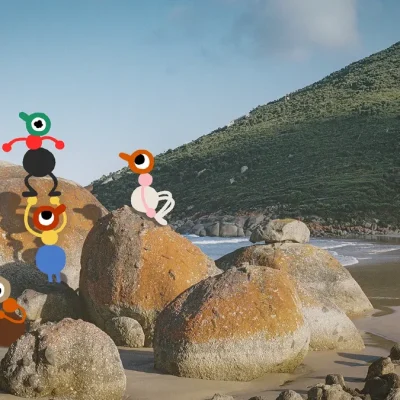


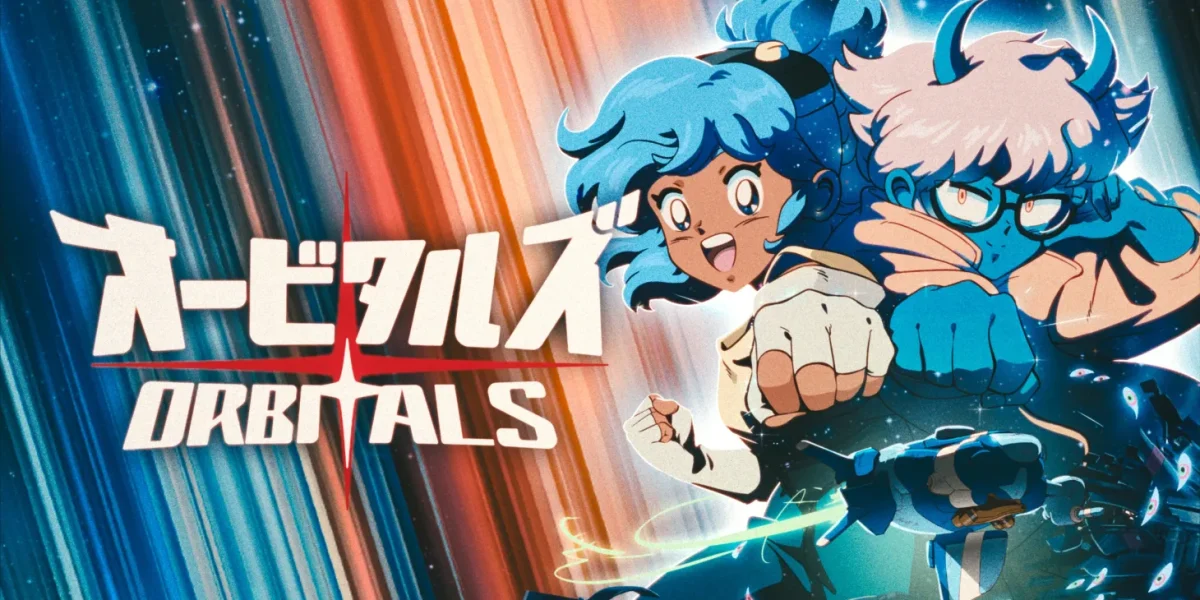

I’ve always believed the video game industry needs more experiences that remind us of the magic of simply playing together—the feeling Hazelight captured so effectively with It Takes Two and later Split Fiction. Now, the creative team at Shape Farm is stepping into that space with Orbitals, a game that attempts to combine the successful formula of puzzle-driven, strictly two-player co-op with the rich, nostalgic aesthetic of ’80s and ’90s anime, drawing inspiration from works such as Cowboy Bebop and Neon Genesis Evangelion, as well as older classics like Astro Boy.
But is Orbitals an exceptional achievement, or merely a one-and-done experience that struggles under the weight of its own artistic ambitions?
After examining every aspect of this roughly ten-hour adventure, the answer falls somewhere in between. Orbitals is a game that shines just as brightly when building its atmosphere as it struggles to fully develop its mechanics and narrative, leaving behind an experience caught between remarkable artistic confidence and noticeable inconsistency.
The Magic of Visual Illusion: A Technical Marvel on Switch 2
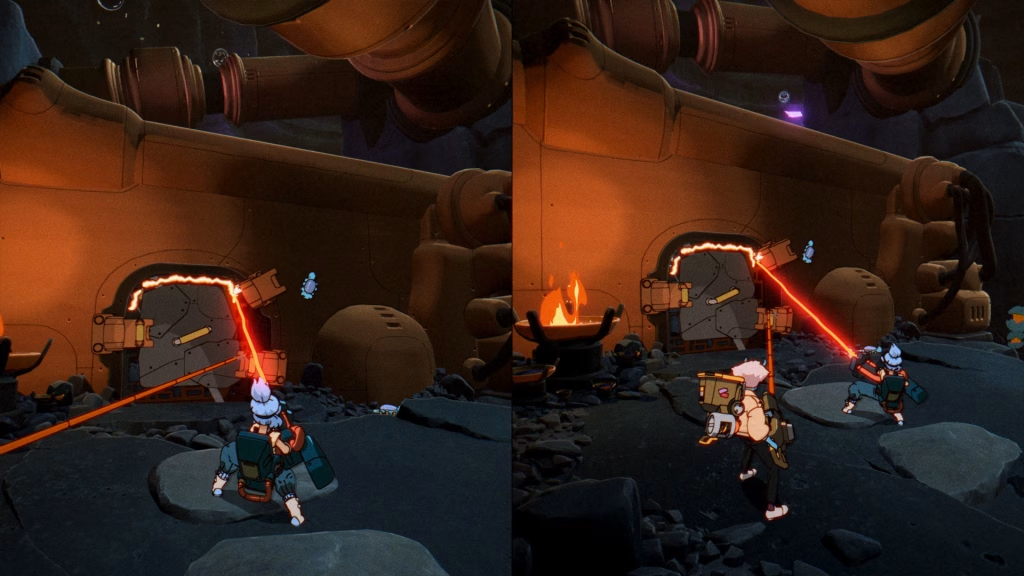
Let’s begin with Orbitals’ best aspect: its visual direction and technical presentation. Shape Farm created this planet with Unreal Engine 5, but the true win is how the studio decides to present it.
The game hits a very steady 30 frames per second on the Nintendo Switch 2. But to get the feel and the look of classic hand-drawn animation, the developers use a clever technical trick: character animations are locked to 24 frames per second but some background elements animate at just 12 FPS.
The varying speeds of animation, combined with the game’s dramatic lighting effects, create an astounding visual illusion. At times it’s uncomfortably easy to forget that you’re navigating a completely 3D environment. Instead, it can be like you’ve inserted a VHS tape of some long-lost anime and are watching it come to life. There is one compromise, however. Orbitals has a split screen presentation all the time, even when playing online, and that might make the experience feel a little crowded and visually busy while playing in handheld mode on the Switch’s smaller display.
Gameplay and Puzzles: Fleeting Brilliance or Shallow Platforming?
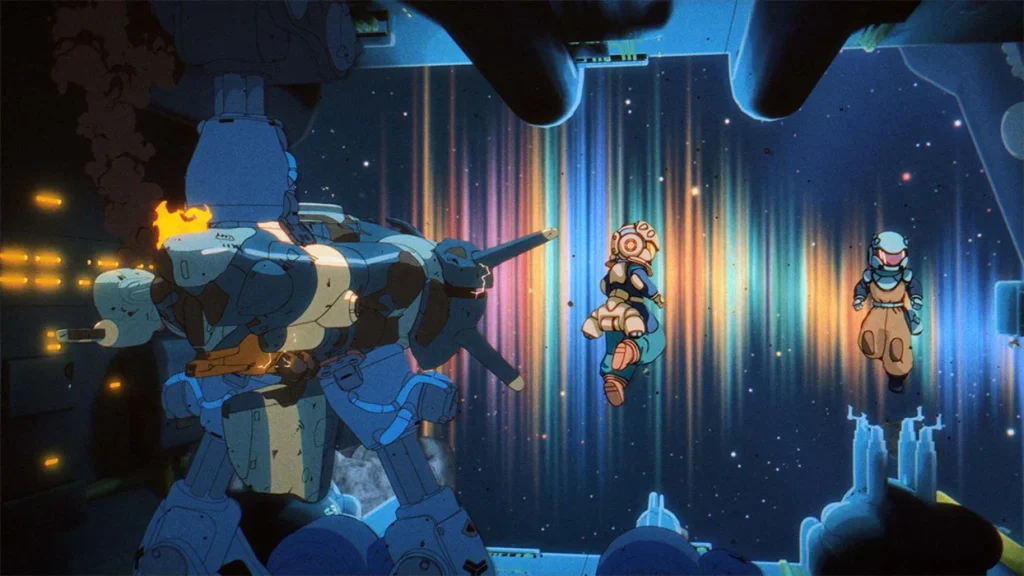
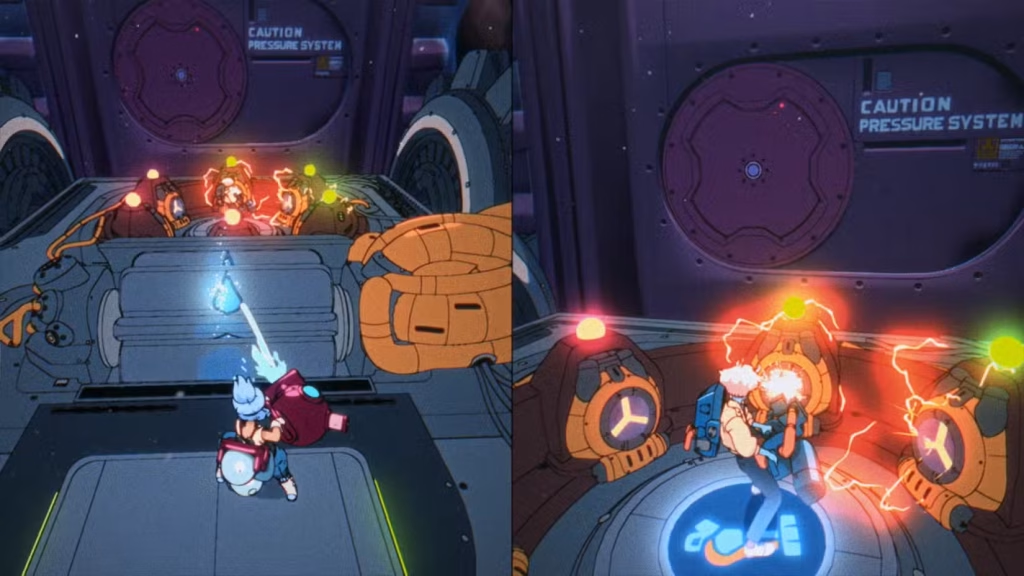
At its core, Orbitals is built around distinctly asymmetric cooperation. You play as Maki, a chaotic, energetic, and relentlessly optimistic hero, and Omura, her more cautious, organized, and calculating counterpart. Along the way, the game gives you access to an eclectic collection of tools, including the Scrap Hook, Liquid Launcher, Beam Cannon, and even stranger inventions such as the Spirit Microwave.
At their best, Orbitals’ puzzles demand genuine cooperation and careful observation of the environment. The game largely avoids the traditional “easy-to-hard” progression. New ideas are introduced at a rapid pace, constantly asking both players to figure out how their respective tools can interact with one another.
From one perspective, that relentless pace gives the adventure an energetic, almost Ghibli-esque sense of curiosity and discovery. The first time you and your partner work together to crack a particularly complicated puzzle, the feeling of success can be incredibly satisfying.
However, that approach comes with its own problems. Orbitals can be surprisingly reluctant to guide its players, and more importantly, it has a habit of introducing genuinely clever mechanics, letting you experiment with them for only a few minutes, and then abandoning those ideas entirely for the rest of the game.
The Spaceship: The Beating Heart of the Experience
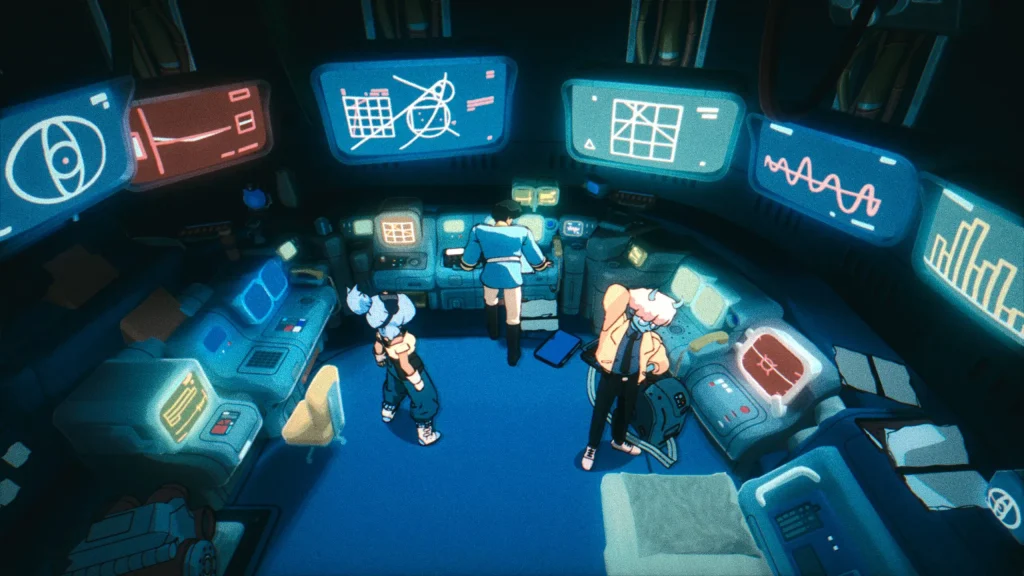
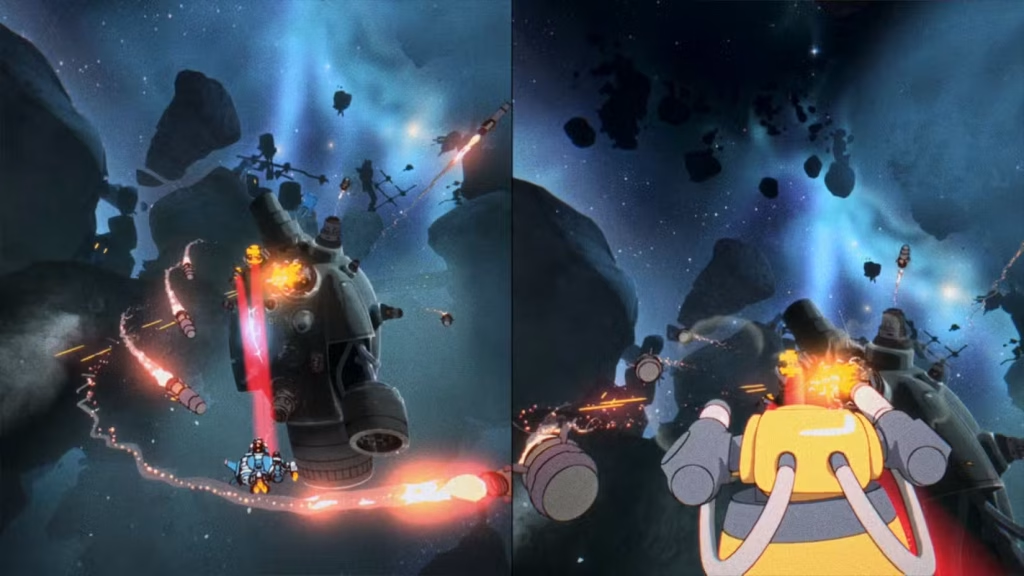
One of Orbitals’ brightest ideas is how it handles travel between levels. Your spaceship isn’t simply a vehicle in the way transportation often functions in open-world games; it serves as a living central hub. Space travel happens seamlessly and at high speed, with one player taking control of the ship and maneuvering between asteroids while the other operates the weapons and fires at enemy spacecraft. The only real annoyance is that vertical movement is handled by the game’s AI, which can become genuinely frustrating.
The ship truly comes alive, however, once you step inside. Exploring the characters’ rooms immediately says something about their personalities: Maki’s messy room comes complete with a drum kit, while Omura’s far more organized space features a piano.
Then there are the smaller activities scattered throughout the ship. You can look after strange space creatures such as capybaras, play minigames like electric jump rope, mess around on the drums, or simply spend some time spoiling your cat.
These seemingly insignificant interactions give the cold metallic structure a surprising amount of personality. More importantly, they turn the spaceship into a genuinely intimate shared space, strengthening the sense of connection between the two players.
Story: An Homage That Never Moves Beyond Fan Fiction
On paper, the narrative foundation of Orbitals promises a deep sci-fi epic—one inspired by giants such as Neon Genesis Evangelion and seemingly interested in examining the very nature of what it means to be human. The story begins with a devastating cosmic catastrophe known as the Storm Wall, a phenomenon that creates fractures in space-time and pushes humanity’s space colony to the brink of extinction.
Faced with this seemingly inevitable fate, the colony’s leaders turn to a strange technology known as the One Mind Machine. During Maki and Omura’s childhood, their physical bodies are destroyed, but their consciousness, emotions, and memories are uploaded and preserved within a kind of cosmic cloud. The characters we control throughout the game are essentially physical manifestations of those digital consciousness, sent into deep space 15 years after the original disaster to search for life-sustaining sources of energy in the form of cassette tapes.
It is an excellent foundation for exploring some genuinely heavy existential and ontological questions. The idea of bodies being continuously reconstructed—which also serves as a clever narrative explanation for the game’s respawn mechanic—gives the writers an opportunity to challenge traditional ideas of the soul and human identity. Throughout the story, Omura repeatedly expresses doubts about this very issue, essentially asking: “After dying and being reconstructed by this machine so many times, am I really still the same person?”
Unfortunately, Orbitals buckles under the weight of these philosophical ideas and never has the courage to explore them in meaningful depth. Its in-game storytelling is often vague, fragmented, and overly restrained, to the point that a significant amount of essential background information and world-building is delivered outside the game itself, requiring players to look beyond the actual experience to understand it.
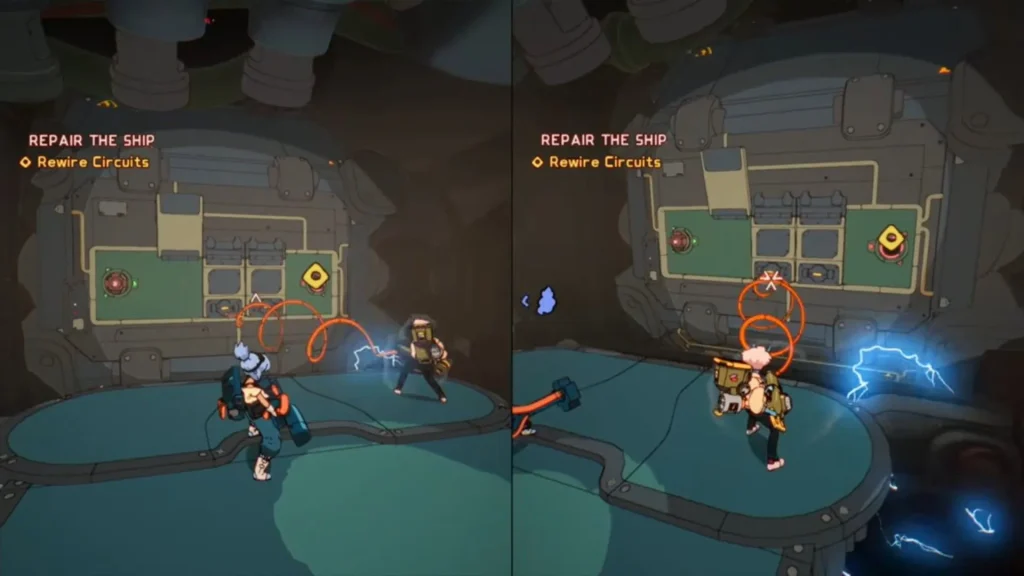
The cutscenes also fail to meaningfully develop or examine the characters. Omura’s existential concerns remain little more than a handful of brief, surface-level lines rather than evolving into an emotional conflict, a meaningful identity crisis, or an important turning point in the narrative.
The way Orbitals communicates information is similarly uneven. Complex concepts, including the darker consequences of using soul-transfer technology, are explained through extremely brief radio conversations delivered by the colony’s leader, Togan. Given the co-op nature of the game, these moments are incredibly easy to miss. If you happen to be solving a puzzle, talking to your partner, or simply laughing together when one of these conversations plays, crucial pieces of information can disappear into the background.
The absence of an in-game Codex or encyclopedia explaining the rules, terminology, and history of this otherwise rich universe only makes the problem worse. As a result, Orbitals’ narrative atmosphere can sometimes feel closer to fan fiction—or a surface-level tribute to ’90s anime—than a fully realized work with an identity of its own. Ultimately, Orbitals’ story is an elaborate and visually captivating frame surrounding a noticeable emotional and narrative void.
Final Verdict
Orbitals may struggle with shallow puzzle mechanics, an uneven final stretch, and a story that never fully explores its ambitious ideas, but its strengths ultimately make the journey worthwhile. Its stunning anime-inspired presentation, exceptional soundtrack, and genuinely intimate co-op moments give the experience an identity of its own.
At around $40, especially with the excellent Friend Pass allowing a second player to join for free, it is also an appealing co-op package.
More importantly, Orbitals understands something fundamental about cooperative games: the destination isn’t always what matters most. Sometimes, the real experience comes from talking through a problem, laughing at each other’s mistakes, and learning how to understand the person playing beside you.
This review is based on the Nintendo Switch 2version
Score: 85/100

Other Articles

A Different Kind of Fog | Silent Hill: Townfall Review
Monstrosity Is Not Destiny | The Blood of Dawnwalker Review