


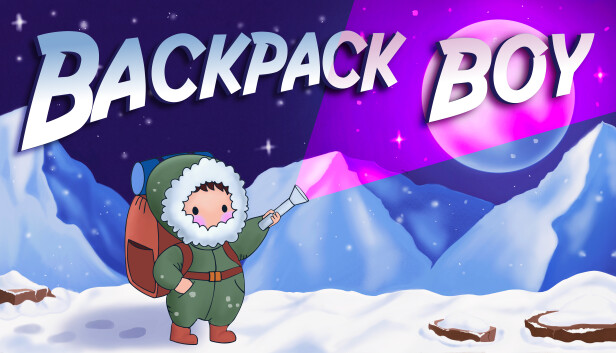

There is an elegance to puzzle games that can build an entire experience around a single idea. Backpack Boy is one of those games. Developed by Chuck and Niles Games, it began as an entry for the 2023 BIGMODE Game Jam before being expanded into a full release, and that origin is still visible in both its strengths and its limitations. This is a compact puzzle-platformer with a genuinely clever central mechanic, smart level design and a strong visual identity, but it also feels like a game that ends just as its best ideas are beginning to mature.
The premise is simple. Backpack Boy discovers a peculiar flashlight while trekking and eventually finds himself exploring an abandoned facility. The flashlight does not simply illuminate the environment; its beam reveals another version of the world, essentially allowing you to interact with spaces that no longer exist in the present.

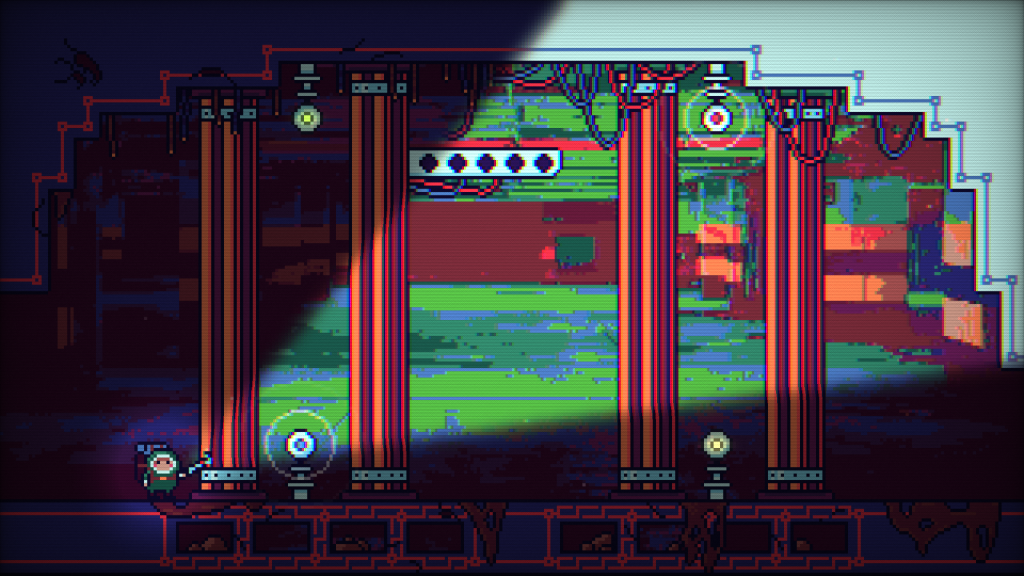
It is an immediately understandable mechanic, and more importantly, one that translates naturally into level design. Early puzzles introduce the concept in straightforward ways. Missing platforms can be restored by shining the flashlight over them, turning the beam itself into something closer to a movable window into another state of the environment. Backpack Boy gradually complicates this idea through positioning, movement and additional tools such as lanterns, which can create larger areas where the alternate version of the world becomes accessible.
The game is at its best when these systems overlap. Rather than constantly introducing unrelated mechanics, Backpack Boy mostly explores different consequences of the same fundamental rule. This gives its puzzles a satisfying internal logic. The solution is usually already visible somewhere on the screen; the challenge comes from understanding how the two versions of the environment interact.
That design philosophy makes solving a room feel rewarding without making the game particularly intimidating. I rarely felt that Backpack Boy was trying to trick me. Instead, its puzzles tend to establish a rule, allow me to understand it and then ask me to apply that knowledge in a slightly different context.

However, this careful accessibility eventually becomes one of the game’s weaknesses. Backpack Boy rarely pushes its mechanics to the point where they become genuinely demanding. Just as I became comfortable thinking in terms of overlapping spaces and manipulating the environment through light, I expected the game to start combining its systems into more elaborate multi-stage puzzles. It occasionally moves in that direction, but never quite far enough.
This creates an unusual difficulty curve: the game becomes mechanically more interesting without becoming significantly more challenging. Its short length makes this even more noticeable. Being concise is not inherently a problem, and I appreciate that Backpack Boy avoids padding its runtime with repeated puzzle concepts. But there is a difference between a game ending before it becomes repetitive and a game ending before its mechanics reach their full potential. Backpack Boy sometimes falls on the wrong side of that line.
The presentation is similarly restrained but effective. The pixel art is colorful and readable, with enough environmental detail to give the abandoned facility a sense of place without distracting from the objects necessary to solve each puzzle. More importantly, the visual design serves the mechanics. The distinction between different states of the environment needs to be immediately understandable, and Backpack Boy communicates that information clearly.
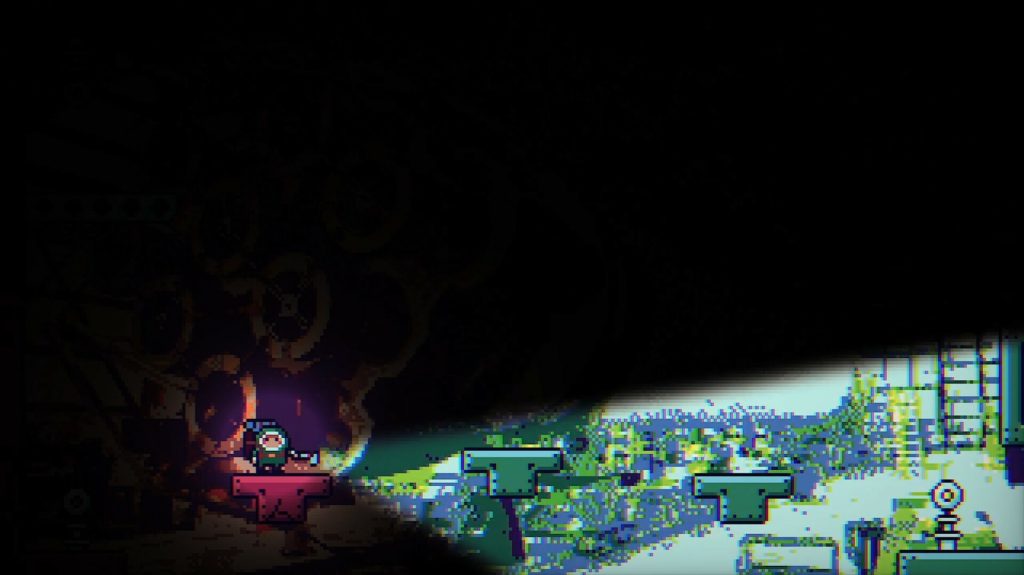
Its atmosphere is also stronger than its cheerful protagonist initially suggests. The deeper I travelled into the facility, the more the game developed a quiet sense of mystery. There is clearly a history behind the location and the strange technology inside it, but the narrative remains deliberately understated.
I enjoyed that ambiguity, although I also think the storytelling could have gone further. The environment raises interesting questions, but the game gives its mechanics considerably more development than its world. As a result, I was more invested in discovering what the next puzzle would do with the flashlight than uncovering what had actually happened in the facility.
Interestingly, the game’s origins help explain both sides of the experience. The original Backpack Boy placed fourth in the Fun category of the 2023 BIGMODE Game Jam, and it is easy to see why: the central concept is immediately playable, visually intuitive and flexible enough to support an entire puzzle game. The full release adds new levels and mechanics to that foundation, but it still retains the tightly focused structure of a Game Jam project.
Final Verdict
Ultimately, Backpack Boy succeeds because it understands its central mechanic extremely well. It does not need a large collection of systems to remain engaging; a flashlight, two versions of the same environment and carefully constructed levels are enough to produce some genuinely satisfying puzzles. I only wish the game had more confidence in pushing those ideas further. What is here is polished, inventive and consistently enjoyable. But its greatest weakness is almost a compliment: Backpack Boy left me wanting to see the more complicated game hidden inside its mechanics.
This review is based on the PC version
Score: 70/100

Other Articles

Akatori Review