



If I’m being completely candid, Nioh 3 doesn’t feel like a routine sequel—it feels like a design manifesto from Team Ninja. After years of iterating on punishing action systems and refining their take on stamina-driven combat, the studio has finally reached a point where Nioh stands entirely on its own, no longer living in the shadow of the “Soulslike” label. This third entry doesn’t merely expand on its predecessors; it recontextualizes their core philosophies. From combat flow to level topology, from boss choreography to buildcraft depth, Nioh 3 represents a confident evolution rather than incremental iteration.
Combat Design: Brutality Engineered to the Last Detail
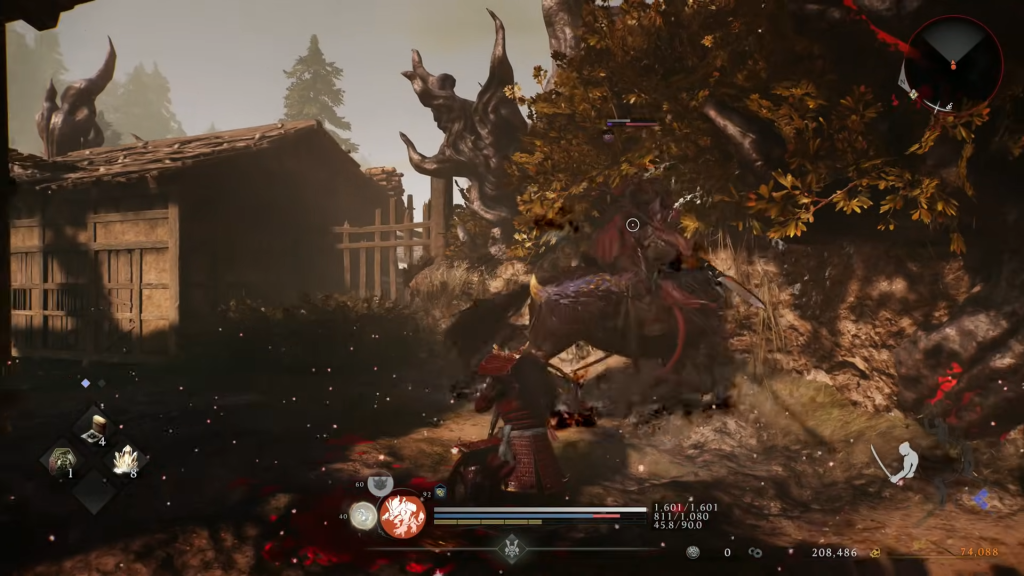
Combat is still the main part of the experience, but in Nioh 3 it feels more flexible, responsive, and expressive. The three-stance system—Low, Mid, and High—comes back, but the changes between them are much smoother. Animation blending has gotten so good that switching stances in the middle of a combo feels natural instead of mechanical. This small but important change turns stance management from a tactical switch into a language of movement all its own.
The Ki Pulse mechanic, which has been a big part of the franchise for a long time, has been changed in a subtle way. It’s not just a place to recover stamina anymore; it’s an offensive boost. Perfectly timed pulses can now activate conditional perks in certain skill trees. These perks can weaken enemies, speed up elemental buildup, or temporarily speed up Ki regeneration beyond its normal limit. What used to be a reactive way to stay alive has become a proactive way to make things work better.
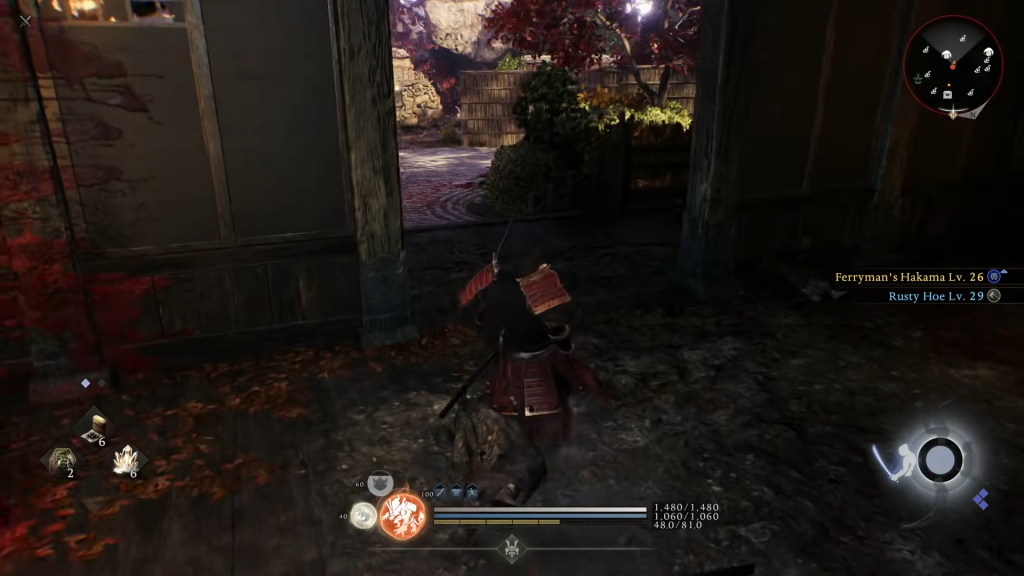
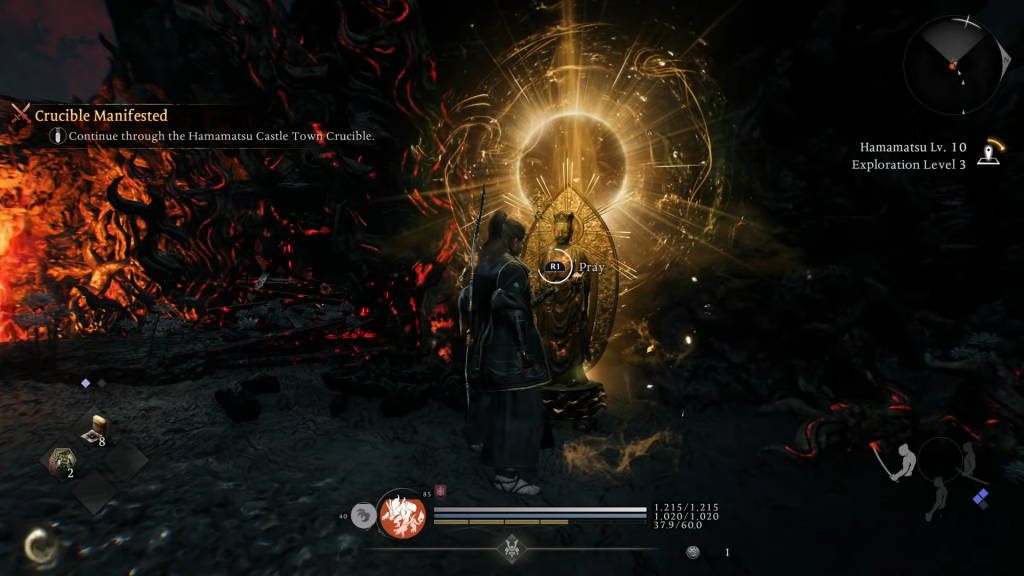
The new version of the Yokai Shift system is another great improvement. Instead of just being a “super mode,” each Yokai form now has a clear job to do on the battlefield. One is great at controlling crowds, another is great at breaking down enemy Ki bars, and a third is designed for doing surgical burst damage when bosses are weak. The resource economy that controls Yokai Shift is very important because it is more strict, which forces players to use it strategically instead of on a whim.
The Art of Psychological Pressure
The way enemies act has become much more advanced. Human opponents now show tactical nuance by moving intelligently, linking defensive moves into counterattacks, and sometimes working together to put pressure on in group fights. Combat scenarios feel less like math tests and more like controlled fights where knowing where you are and what to shoot at first are the most important things.
On the other hand, yokai enemies have unique tempo signatures. Some people purposefully add irregular attack delays to punish people who dodge based on rhythm. Some people change the arena space, which makes players have to change their stance choice on the fly. Each type of enemy has its own behavior, which makes it feel like you’re fighting real people instead of scripted robots.
The boss fights in Nioh 3 really show how mature the game’s design is. There are more elaborate visual effects and bigger arenas, but hitbox integrity and telegraph clarity are still very well-controlled. Even the most chaotic-looking battles don’t usually feel unfair. Systemic ambiguity doesn’t usually cause deaths; instead, they are usually caused by overextending yourself or not managing your stamina well.
The way phase transitions happen in boss fights is very well done. Movesets change over time instead of starting over, and changes in the environment change the way spacing works in small ways. These fights are less about wearing down the other person and more about being able to read patterns—figuring out how people act when they’re under pressure.
Level Design: Freedom with Structure
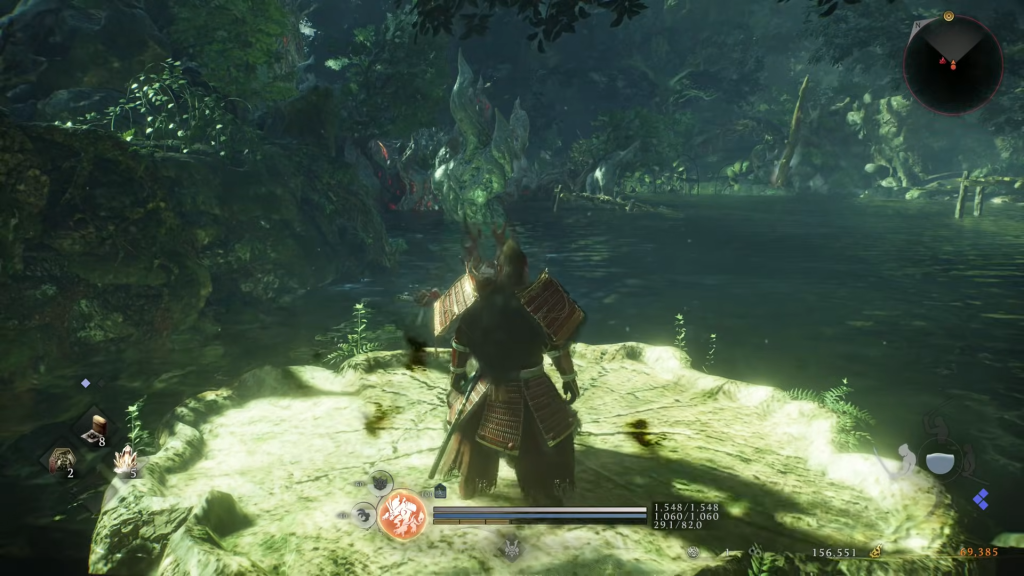
Nioh has always had a linear structure based on missions, but Nioh 3 tries out a semi-open framework. Areas are bigger and more connected, but they still have a planned pacing. There are multiple branching paths, optional mini-bosses, and layered shortcuts that give the game a sense of exploration without making the structure less clear.
The design of shortcuts is still a master class in spatial satisfaction. Opening a hidden gate that leads back to a shrine gives you that classic dopamine rush, but in this case, the shortcuts often lead to other paths, which changes the way you think about how to get around. The architecture of each level makes sense; vertical layers, interwoven paths, and important spatial landmarks help players make mental maps instead of just moving forward.
Loot, Progression, and The Conflict Between Depth and Density
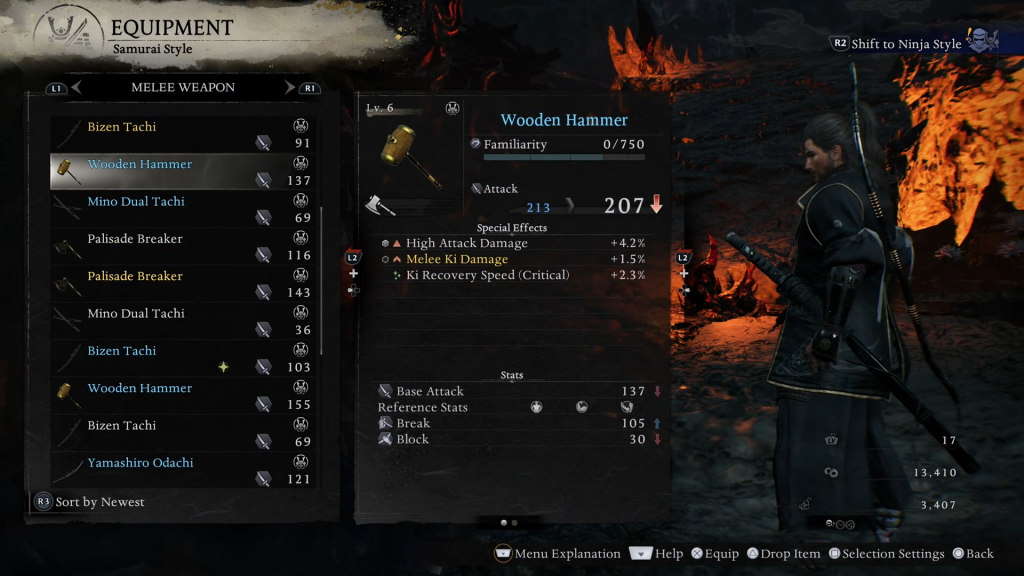
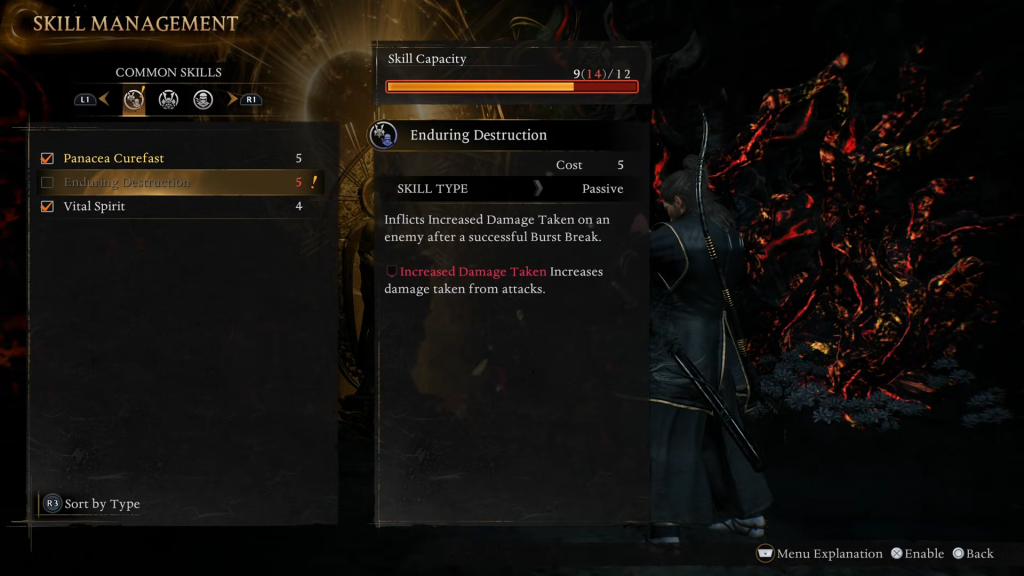
Fans have always been divided over the franchise’s Diablo-style loot system. Nioh 3 is better than the first two games, but it doesn’t lose its complexity. There is less clutter, and tools for managing your inventory are easier to use. Itemization has been made easier. Set bonuses make it easier to see how they work together, which makes players want to focus on certain builds instead of stacking stats when they can.
But it’s still hard to figure out how the system works. Players who aren’t as into the game might have trouble with stat modifiers, natural affixes, guardian spirit interactions, and skill tree cross-synergies. But if you’re willing to put in the time, the buildcraft potential is amazing. It’s possible to make hybrid builds that combine elemental procs with Ki-drain mechanics or Yokai ability amplification. These builds also give you an edge in battle.
A New Look at the Myth: Visual Direction and Technical Fidelity
Nioh 3 is a clear improvement from a technical point of view. The lighting reacts more dynamically, the texture fidelity is sharper, and the particle effects, especially during elemental clashes, are visually striking without being too much to handle.
But what really stands out is the art direction. The game goes deeper into stylized versions of Japanese folktales. Yokai designs are both considerate and new. They mix old symbols with modern, over-the-top style. The colors go from muted realism to surreal vibrancy, especially in the Yokai Realm’s distortions. This makes a strong visual contrast.
The animation work is really good. You can feel the weight shift when you swing a heavy weapon, and small animations during stance changes show you what you want to do with your body. This degree of detail makes the game more immersive and makes the mechanics easier to understand in a system that depends so much on frame accuracy.
Audio Design: Tension in Layers
The music combines traditional Japanese instruments with modern orchestral layering. As boss fights get harder, the themes get more complex, adding more instruments as the fights get harder. This adaptive layering adds to the dramatic momentum without taking up too much space in the sound.
Sound design is very important for how things work. The metallic sound of blades hitting each other, the sharp sound of a Ki break, and the low-frequency hum of a Yokai Realm activation are all important ways to get the necessary feedback. In high-pressure situations, these cues often help people make decisions just as much as visual telegraphs do.
Hard and Fair: Not Random, but Necessary
Nioh 3 is still hard, but the way it gets harder is more planned. Early encounters act as useful tutorials, quietly teaching you how to use Ki and time Burst Counter. But by the middle of the game, it assumes that players know how to read and write. Enemy combinations get harder, and you have to follow boss patterns exactly.
It’s important to note that level grinding alone won’t get you ahead. To be successful, you need to be good at mechanics and have a consistent build. The challenge seems real instead of made up.
Final Verdict
Nioh 3 is the most confident game in the series. It doesn’t feel like a copy of a genre anymore; it feels like a fully realized design philosophy. Its combat is layered and expressive, its bosses are smart and dramatic, and its progression systems are hard but rewarding.
Yes, complexity may turn off players who want things to be easy to get to. And yes, some side missions do use the same structural patterns over and over again. But these are only small problems in an otherwise well-made experience.
Nioh 3 was more of a discipline to study than a game to finish for me. Every loss made me better; every win felt like I had really worked for it. Not only is it a sequel, but it is also the end of the story. It shows how good Team Ninja is at making high-intensity action RPGs and is a defining statement in the genre’s ongoing evolution.
This review is based on the PS5 version
Score: 85/100

Other Articles
Reanimal Review



I admire your piece of work, thankyou for all the great articles.