


Boss rush games strip away much of what surrounds an action game’s climactic encounters. Lengthy stages, groups of regular enemies, and extensive exploration give way to recognizing attack patterns, reacting at the right moment, and defeating enemies designed as individual tests of skill.
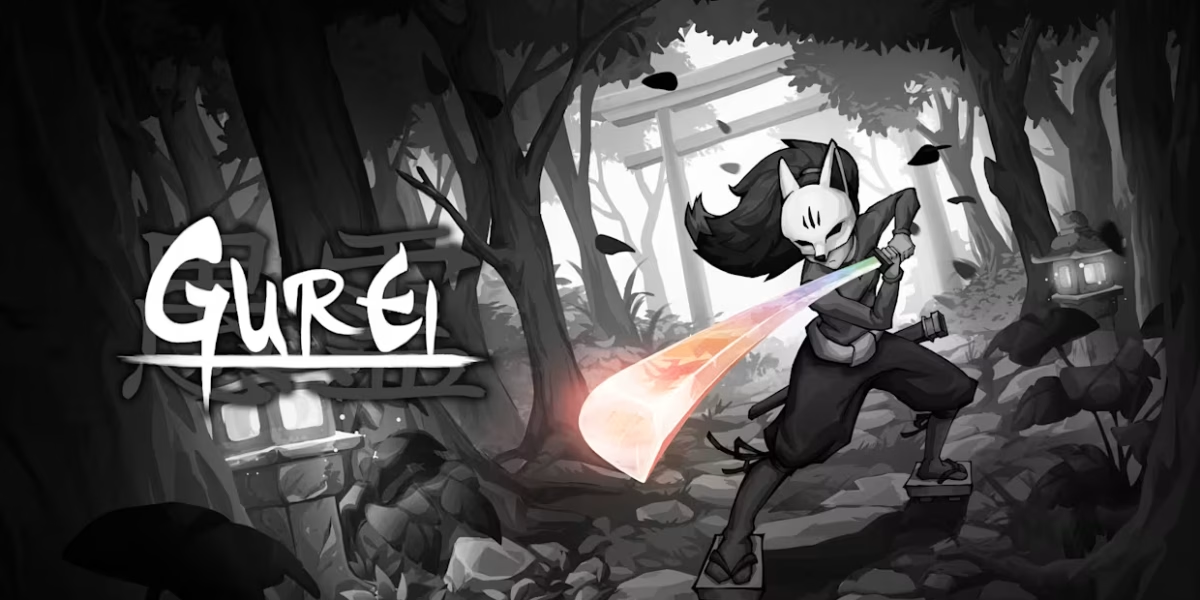
Gurei combines this formula with roguelike elements, but its most interesting feature is not simply death and repetition. Instead, it is how the order in which you challenge its bosses reshapes the difficulty and strategy of an entire run.
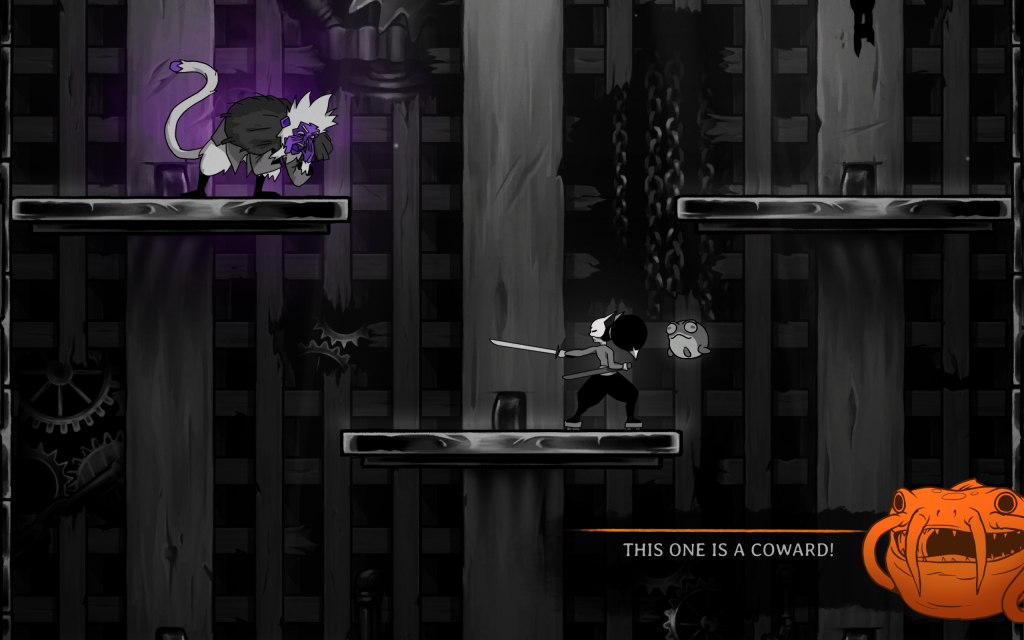
Players take control of Rei, a human spirit tasked with defeating mythical beings known as the Kami. The narrative remains firmly in the background, with information about Rei, the world, and the Kami delivered through brief conversations. After each boss is defeated, that Kami joins the others in a separate space where short exchanges take place. Some of these conversations change depending on the order in which the bosses were defeated.
This approach initially creates curiosity, suggesting that a larger story is hidden behind the game’s monochrome world and the relationship between Rei and the creatures she encounters. However, the dialogue is too brief and fragmented to form a clear narrative. Even after several runs, the connection between many of the characters and events remains difficult to understand.
Changing the dialogue according to the boss order is an interesting way to encourage replayability, but it does more to imply the existence of a deeper story than to tell one coherently.
Simple Controls, Complex Decisions
Gurei’s controls are deliberately straightforward. Moving, jumping, dodging, and attacking form the foundation of Rei’s initial abilities, allowing players to understand the basics almost immediately. The game does not ask you to memorize lengthy combos or master an overly complicated combat system. Its depth instead comes from learning the bosses, deciding the order in which to challenge them, and using the abilities acquired after defeating each Kami.
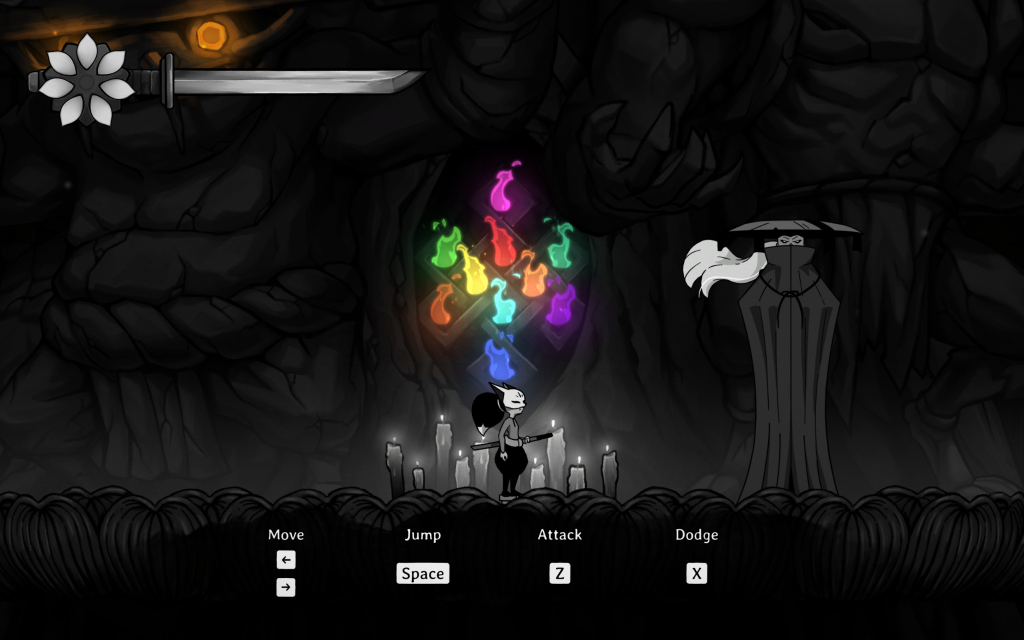
Every boss grants Rei a unique power. Some provide defensive options, while others expand her attacks or movement. Choosing your next opponent is therefore not simply a matter of identifying the easiest fight. You must consider which ability will be most useful later, which bosses become especially dangerous at higher levels, and which order gives you the best chance of completing the run.
During the first few attempts, however, this freedom is not fully informed. You do not yet know which ability each boss will grant or how that boss will change when encountered later. The opening runs consequently feel like a process of gathering information.
Gurei gives players freedom before giving them the knowledge required to use it effectively. There are no permanent upgrades that make Rei stronger after failure. What carries over is your understanding of each boss, its reward, and its most dangerous position in the order. Boss selection only becomes genuinely strategic after several attempts have shown you what each route involves.
Difficulty That Changes the Fight
The increasing difficulty of Gurei’s bosses is not limited to larger health bars or stronger attacks. The later a boss appears in a run, the faster and more mechanically complex the encounter becomes.
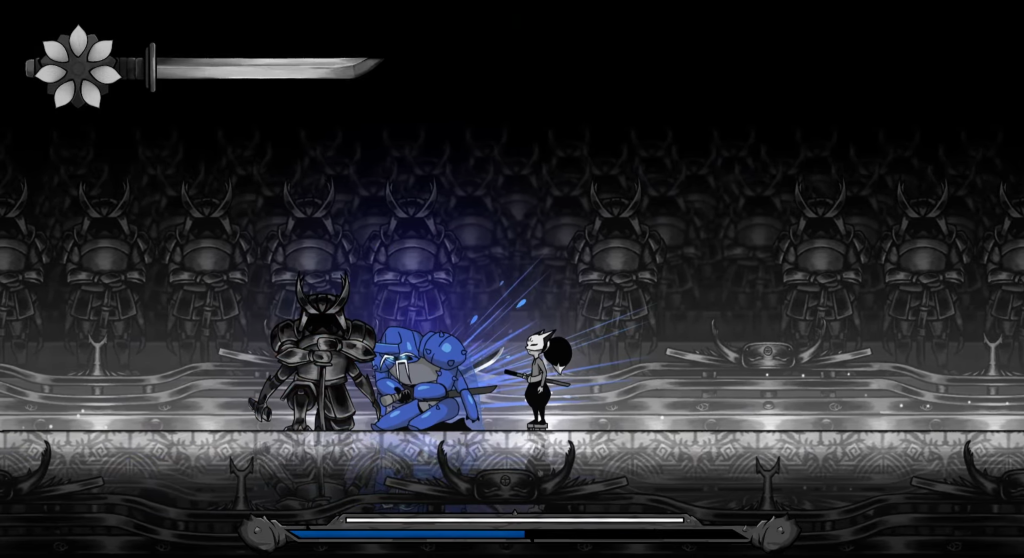
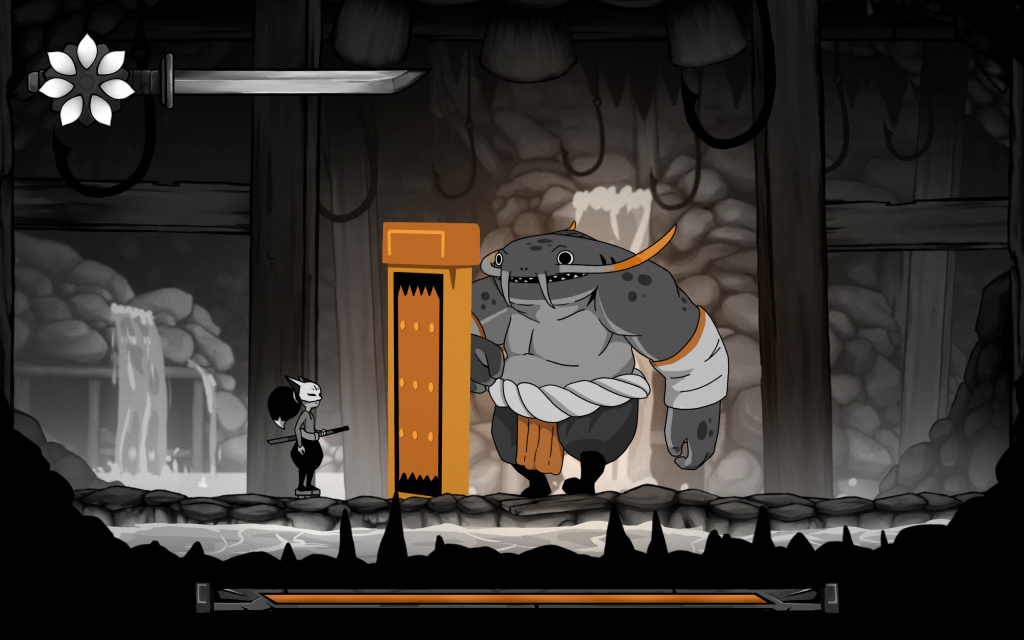
The Beetle is a clear example. When fought early, it reacts more slowly and relies on a relatively limited set of attacks. It can strike with its katana or summon soldier-like figures resembling itself, which suddenly fall from the background onto Rei’s position.
When saved for the final encounter, almost every part of the fight accelerates. The Beetle moves toward Rei more aggressively, swings its sword faster, and drops its soldiers with far less warning. It feels as though the entire battle has been played at twice its original speed.
It also gains a new attack in which it spins its katana like a fan, pulling Rei toward itself and forcing the player to escape before being caught in its range. The fight lasts considerably longer as well, since Rei deals less damage and must spend more time avoiding increasingly rapid attacks. What was initially a manageable encounter becomes a demanding test of concentration and positioning.
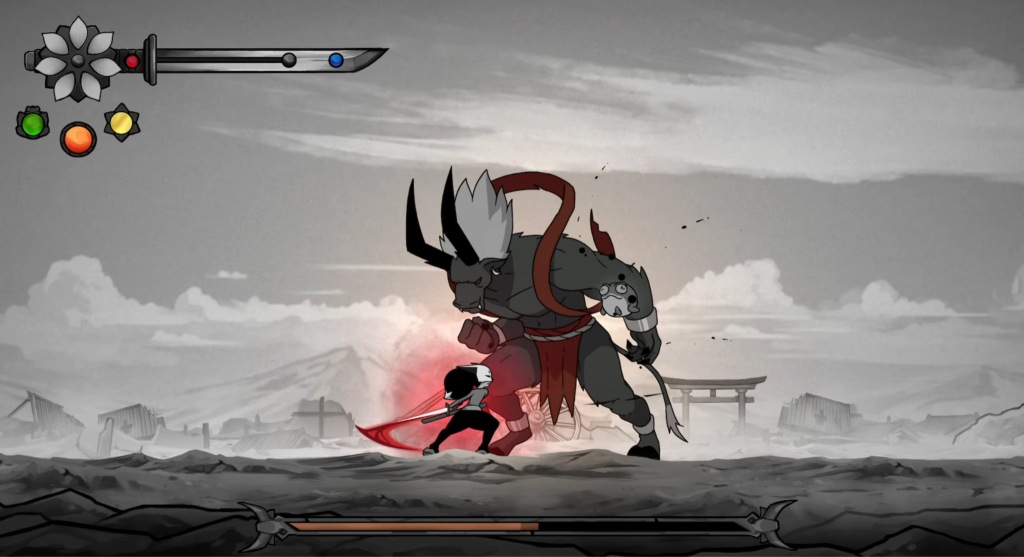
The Bull demonstrates the same system in a different way. When fought first, it is calm and mechanically simple, mainly jumping into the air before crashing down onto Rei with both feet.
Later versions expand this basic pattern considerably. The Bull begins attacking with its hands, causes rocks to erupt from the ground, and creates clouds of dust that obscure its location. While visibility is limited, rocks can suddenly emerge beneath Rei’s position, forcing the player to move or jump based on limited information.
Even its original jumping attack becomes more dangerous, as the Bull’s landing causes additional rocks to burst from the ground. The game does not merely increase the numbers behind the encounter. It transforms a simple attack into the foundation of a larger and more demanding moveset.
These examples show why boss order is more than superficial freedom. Knowing a boss at its easiest level is only the beginning. Leaving that same enemy for later can change its pace, attack combinations, and the amount of attention required to survive.
The pressure of failure also becomes more intense as a run continues. The further you progress, the more time and concentration you have invested, and a single mistake can send you back to the beginning. For players who enjoy demanding games, this tension will be part of Gurei’s appeal. Those who dislike repeatedly retracing the same route may become tired of its structure much sooner.
Bosses That Bring Color to the World
Gurei’s visual design is one of its most distinctive qualities. Most of its world is rendered in black, white, and gray, while each Kami is associated with a specific color. The pink cat, purple monkey, and red dragon immediately stand out against the otherwise colorless environment, giving every encounter its own visual identity.
This selective use of color is more than an attractive stylistic decision. In a world almost entirely drained of color, each Kami appears to bring its own personality into the scene. Their attacks are also easier to distinguish from the background, allowing the visual design to support the readability of the fights.
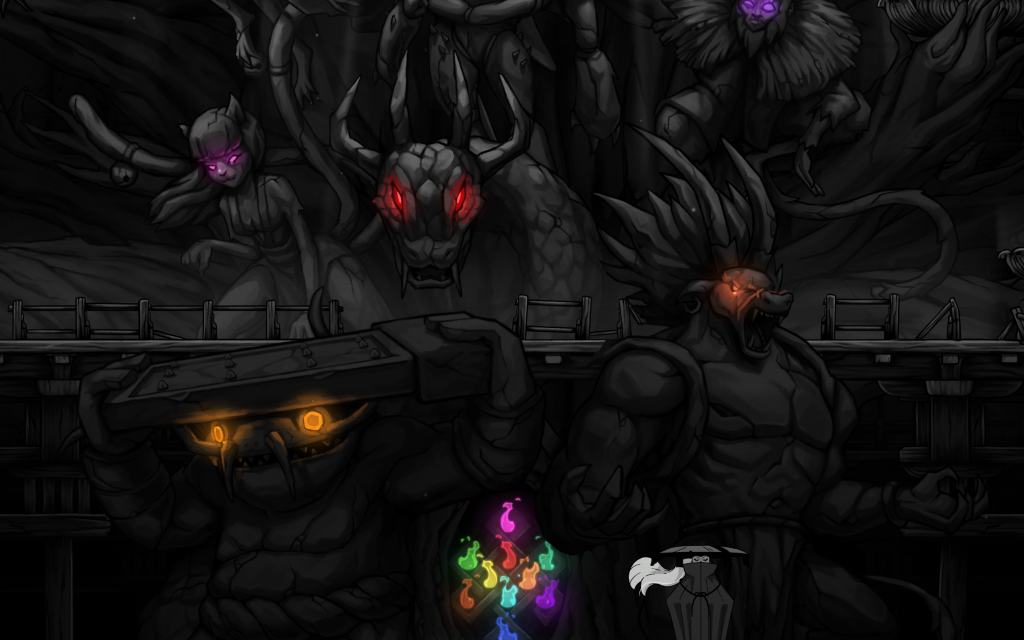
The bosses are not merely differently colored versions of the same template. Each has a distinct appearance, identity, and set of attacks. The noticeable differences between their earlier and later forms help the encounters remain engaging despite the simplicity of Rei’s initial moveset.
The abilities collected throughout a run gradually expand Rei’s available options, but Gurei remains less interested in elaborate combinations than in finding the right moment to attack and responding correctly to each enemy’s behavior.
A World That Quickly Feels Empty
A limited number of NPCs are scattered across the map. The game does not always explain how to interact with them, so players occasionally have to discover the correct method on their own. These interactions are amusing during the first few encounters and briefly make the world feel more mysterious.
However, the small number of NPCs and the relative emptiness of the map soon become apparent. Since Gurei concentrates so heavily on its boss battles, the spaces between those encounters lack enough content to sustain a lasting sense of exploration. After two or three runs, most of the available interactions have already been discovered.
The player’s priorities also change. During the opening attempts, you may still be interested in discovering the world, finding new characters, and understanding how to interact with them. After several defeats, that curiosity is replaced by a desire to complete the game as efficiently as possible.
Instead of wondering what may have changed in the world, you begin thinking about which boss should be defeated first, which ability should be acquired next, and which route offers the best chance of finishing the run. The map gradually stops feeling like a place to explore and starts functioning as a space separating one boss encounter from another.
This is where Gurei’s focused design becomes its greatest limitation. The bosses continue to reveal new attacks as the player gains experience, but the world surrounding them does not evolve at the same pace. Once its limited discoveries have been exhausted, the hub begins to feel like an extended boss selection screen rather than a meaningful part of the adventure.
Repetition as Both Strength and Weakness
Gurei builds its identity around repetition. Changing boss patterns, abilities acquired in different orders, and dialogue variations provide reasons to begin another run. Every failure can teach you something that improves the decisions made during the next attempt.
However, repetition becomes increasingly mechanical once the NPC interactions have been exhausted and the story remains unclear. From that point onward, the main motivation is no longer discovering the world but optimizing the boss order and executing a familiar route more effectively.
For players who enjoy studying attack patterns, refining their performance, and finding increasingly efficient strategies, this loop can remain highly engaging. Players expecting each run to provide substantial new narrative or environmental discoveries will notice the game’s limitations much earlier.
At its best, Gurei demonstrates that an action game does not require complicated controls to create meaningful depth. Rei’s initial actions are simple, but selecting the right boss order and adapting to increasingly dangerous versions of familiar enemies add a compelling strategic layer to the experience.
Ultimately, Gurei is a focused boss rush with a distinctive identity, striking visual design, and an intelligent approach to difficulty scaling. Its most important form of progression does not occur through permanent upgrades, but through the player’s memory and understanding. Every defeat reveals useful information, and every new run offers an opportunity to turn that knowledge into a more effective route.
Yet its unclear narrative, limited NPC population, and increasingly empty overworld prevent the game from fully realizing the potential of its central idea. Gurei offers a demanding and replayable experience for fans of boss rush games, but the world surrounding its battles never becomes as developed or memorable as the Kami themselves.
This review is based on the PC version
Score: 75/100

Other Articles

Midnight Moments Review
Moss: The Forgotten Relic Review